Marks on the land: the rock engravings of Tswalu
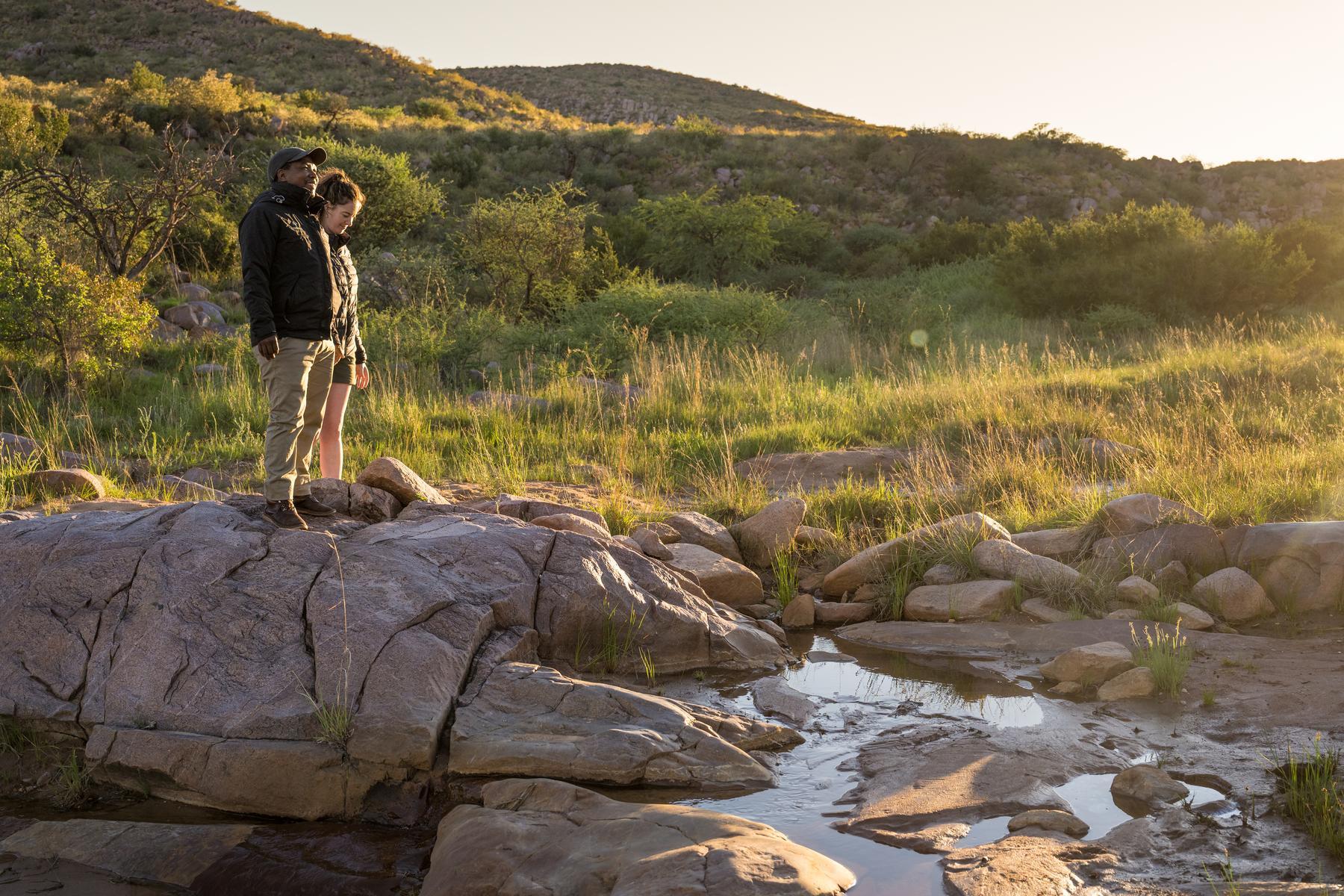
There are places on Tswalu where the rock holds memory. Not the kind that can be read like a text or decoded like a map, but something older and less certain, a presence that asks to be felt rather than explained.
At Steenkamp, Klipbak and Picnic Valley, all within the reserve, and at Nchwaneng on Tswalu’s boundary, rock engravings have been chipped and scratched into stone surfaces that were already ancient when the first images were made. Some may be tens of thousands of years old, others, perhaps only a few centuries.
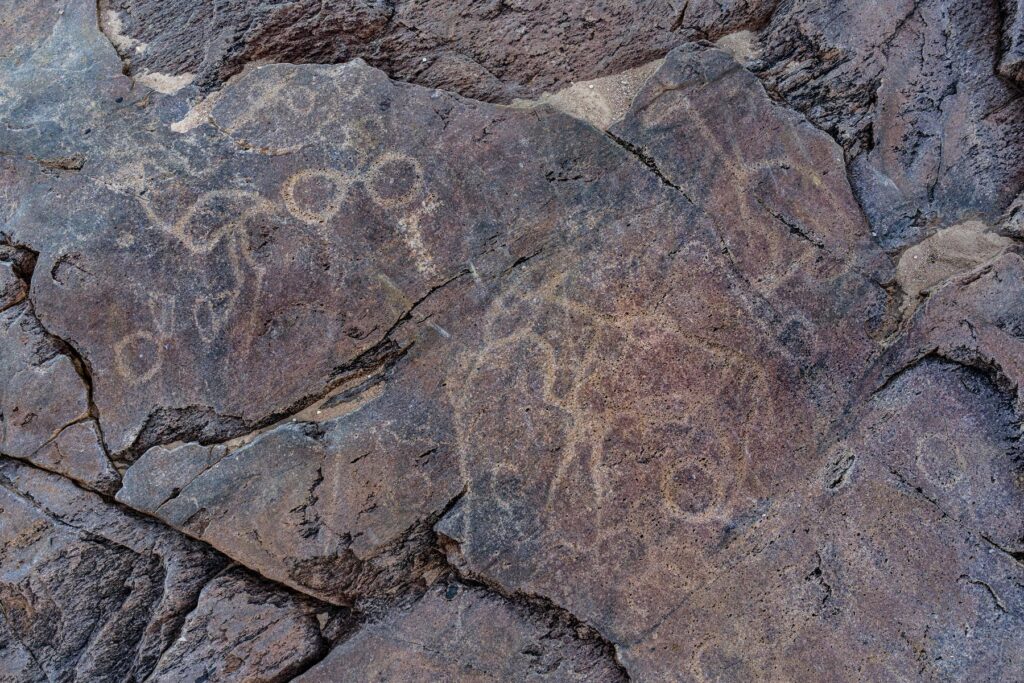
Rock art is the broad term used in archaeology for any mark made by human hands on a natural rock surface. It encompasses paintings, engravings and carvings. The engravings at Tswalu are referred to as petroglyphs, the archaeological term for marks carved or pecked directly into stone, typically using a hammerstone or chisel, to reveal the contrasting lighter surface beneath.
Dating them precisely remains one of the great challenges of southern African archaeology, and in many ways the uncertainty is fitting: these marks exist outside ordinary time.
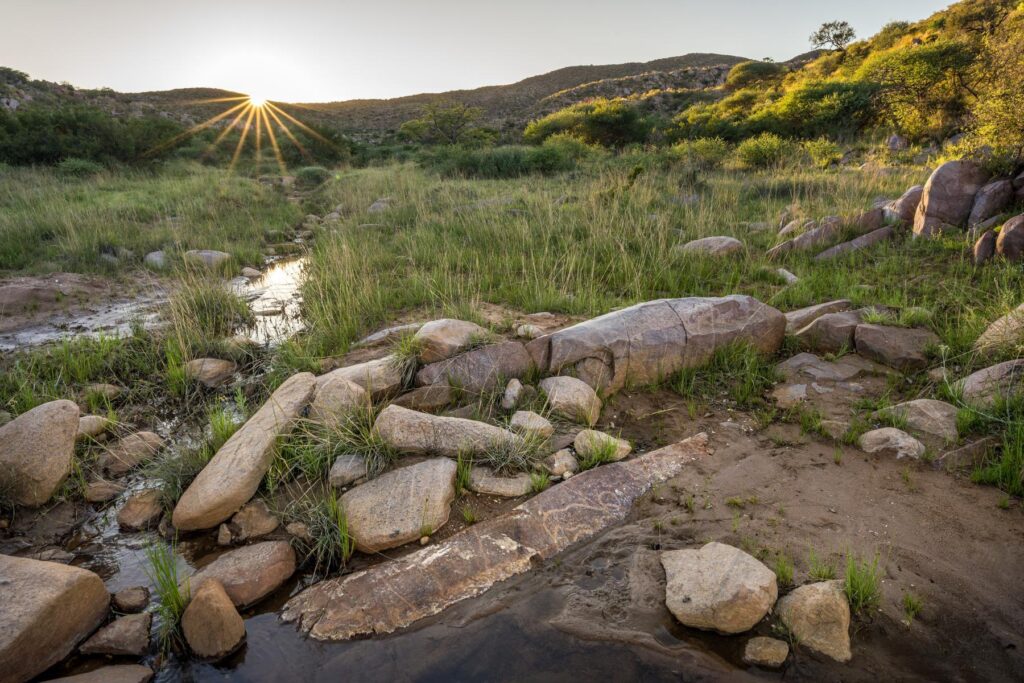
What is certain is where they are found. Every engraving site at Tswalu is associated with water. This is not a coincidence. In the world of the |xam and other San-speaking peoples who once lived across this landscape, waterholes were inherited places, passed down through families, remembered across generations. They were also charged with danger: places where predators came to drink, where strangers might appear, where the boundary between the everyday world and the spirit world grew thin.
Hilltops carried similar significance. The ! giten, figures translated, imperfectly, as sorcerers, were understood to haunt the mountains and, at times, to live in the waterholes as fallen stars. They frequented the places where pigments such as haematite were mined. That haematite may have been rubbed into the engravings themselves or painted onto men’s backs as protection against lightning. The Rain Bull, !khwa ka xoro, was ritually captured and slaughtered on hills where water collected, so that its blood might flow down and soak the dry ground. Young women at puberty were secluded in huts on those same hilltops. Even today, stories persist about water spirits, young girls said to protect the small creatures, frogs and tortoises, living at the edges of pools and pans.
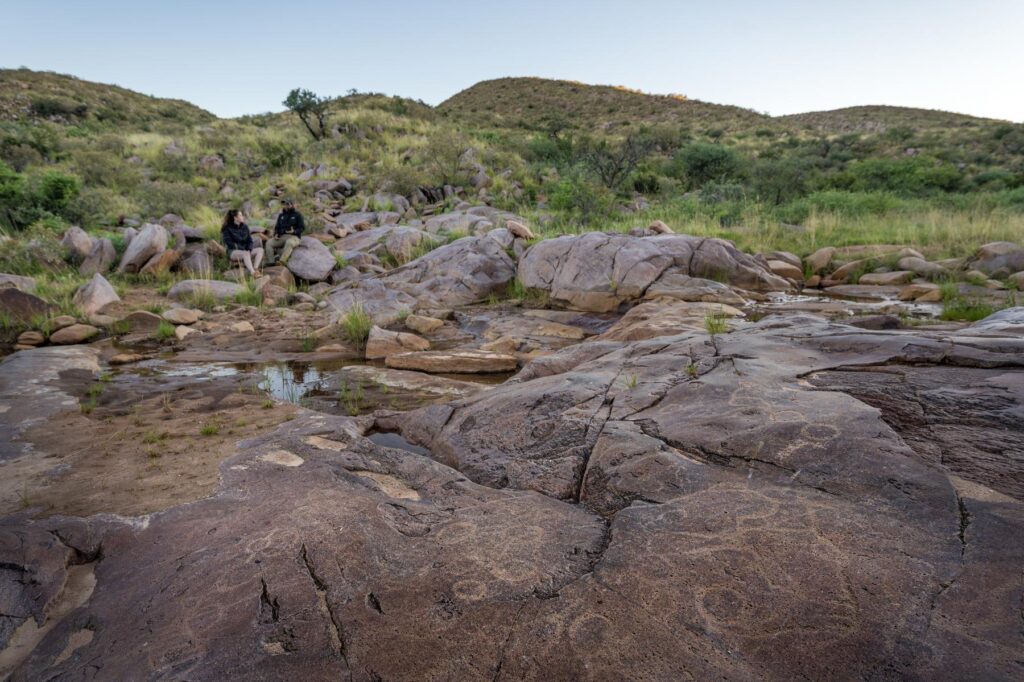
Each of Tswalu’s engraving sites carries its own character within this shared context. Klipbak is a high point in the landscape, a rich site associated with toolmaking, rainmaking and, in the engravings themselves, human figures and cupules. Cupules are depressions, resembling the shape of an inverse dome, pecked into rock surfaces by repeated percussion with a hammerstone. They are found on every continent except Antarctica, and some specimens in the southern Kalahari are suggested to be in the order of 410,000 years old. Their purpose remains largely unknown, and that uncertainty is itself significant: whatever they meant, they were not practical objects. At Klipbak, as Professor Pippa Skotnes observes, they are shapes one could imagine in one’s own flesh. The Damara word for engravings, !ā|ūisa, is a direct translation of the physical action of making them, a reminder that the body was present in this practice long before interpretation enters the picture. At Nchwaneng, dozens of engraved figures and abstract shapes mark a low hillslope with views across the landscape toward the setting sun. Water fills the depressions and hollows in the rock, and the engravings would have been felt underfoot as people approached the pools. At Steenkamp and Picnic Valley, water has smoothed the rock surfaces over centuries; when the sun is low, shadows gather in the engraved hollows and the marks become visible from a distance. The engravings have outlasted everything that made them, the hands, the people, the language, while all around them, animals continue to leave their own fleeting impressions in the mud and sand at the water’s edge.
Professor Skotnes, who has studied these sites over many years and leads the Animal Collegium research project at the Tswalu Foundation, offers a framework for approaching them that resists easy interpretation. Central to it is a concept from the |xam, a San people of the Northern Cape: !gwē, a presentiment described as a tapping feeling in the body, often experienced in one’s own scars, capable of communicating the presence of animals or danger across distance. The elder ||kabbo described this sensation as a kind of letter, something that carries thought through space. When received, it registered in the body as |kamm. When a relative of ||kabbo was shown a copy of a rock painting, he described it as !gwē and responded not with a visual interpretation but with a discussion of rain, its associated prohibitions, and its power to kill.
In this understanding, a picture is not a representation of something in the world. It is a way of sensing things that are not present.
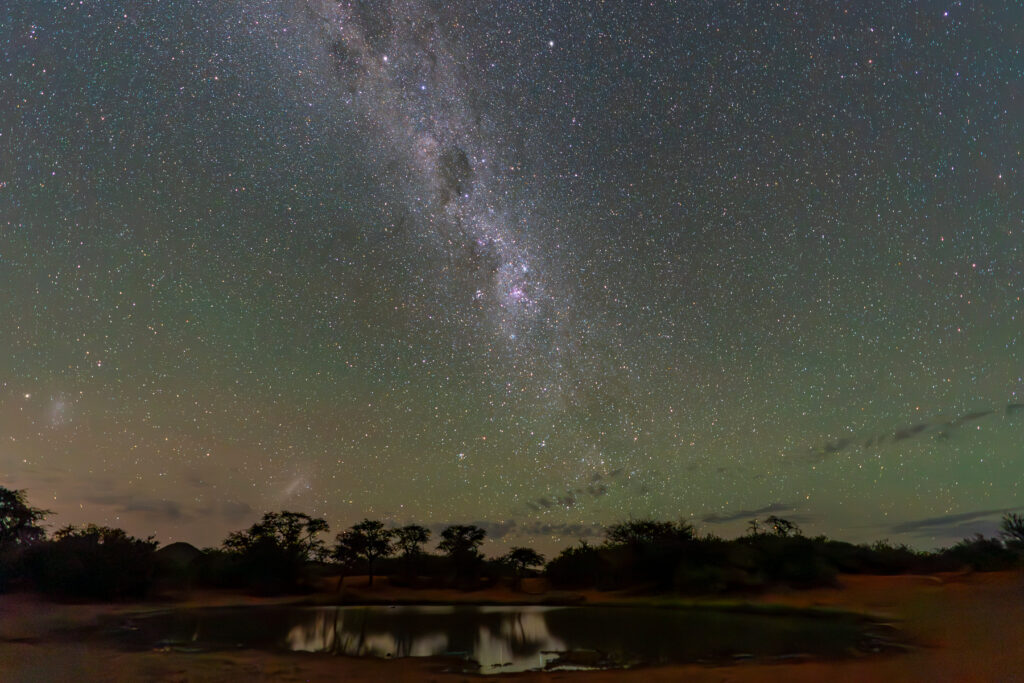
The people who made these images did not experience them as isolated objects. The scattered engravings across the Tswalu landscape would have been felt as a living whole, not pictures in frames, but a web of connected presences, circumscribing a space known through the body as much as through the eye. The rock pools between engravings reflect the stars on clear nights. The hilltops where ! giten worked are the same hilltops from which guests today watch the Kalahari sky darken and the first stars appear.
To visit these sites is to be invited into that continuity. Not to decode what the marks mean, but to notice where they are, to feel the pull of water in an arid landscape, and to sit for a moment with the question of what it meant to live so fully inside a world this alive with meaning.


